When I talk about my travel plans, one question often comes up quite quickly: Why do I choose to take the night train, for long routes such as Vienna to Bucharest in Romania or even further from there to Chișinău in Moldova? One could just take a flight, or even better, not go there at all — after all, tourist hotspots like Barcelona or Mallorca are supposedly much better, warmer, and can be reached in two hours for under 30€ with Ryanair. But for me, taking the night train is not about arriving as quickly as possible or covering long distances in a short amount of time. Rather, it’s about the feeling of being on the move and traveling consciously, as you’ll see more clearly in the following lines.
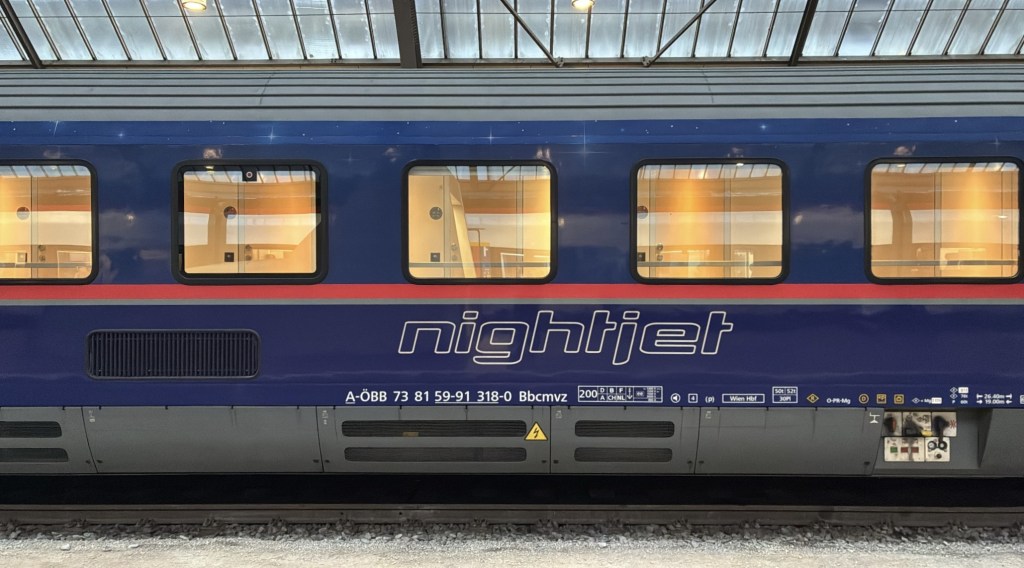
The anticipation of waking up in a new world
As we all know, anticipation is the greatest joy. That’s why there’s something special about standing on the platform in the evening, waiting for the night train to roll in, knowing that all you have to do is close your eyes once and you’ll wake up the next morning as if teleported into a new environment — enjoying breakfast in your still-warm bed in a couchette or sleeping car. Of course, the night can sometimes be better or worse, depending on your compartment companions or the condition of the tracks. But the anticipation of stepping off the train right in the center of an unfamiliar city often makes you forget the occasional nighttime awakening.
„Lying down in a bed, drifting off, sleeping seven or eight hours while your destination draws closer. Waking up rested somewhere, rubbing your eyes, and realizing you’ve arrived. Stepping out with the feeling that the journey passed in no time, even though you traveled for ten hours. That is magic.“ (Andersson, 2020)
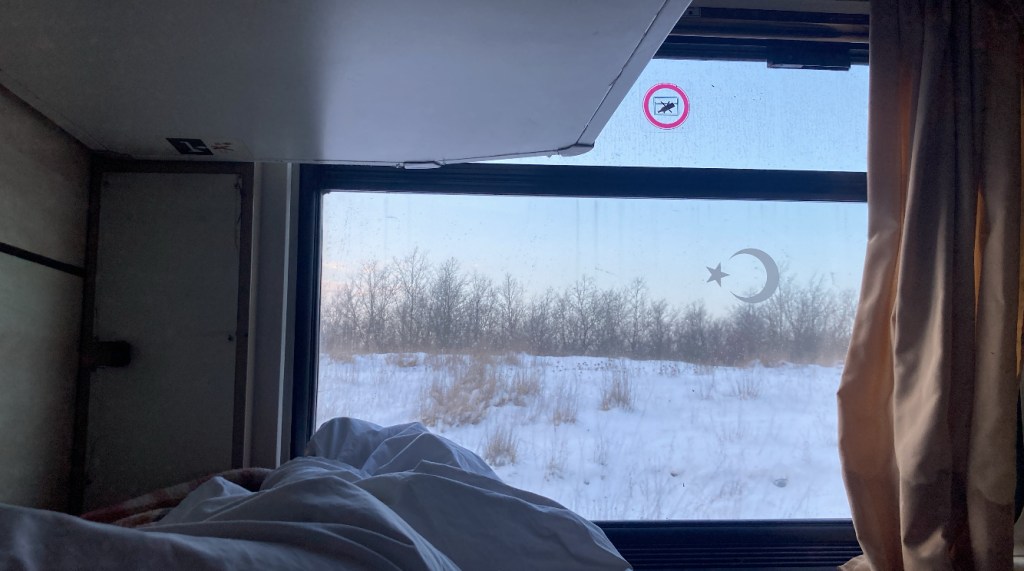
The compartment companions
It may sound a bit odd at first, but the fellow passengers in the compartment can also make a night train journey unique. Admittedly, it often doesn’t go beyond a brief hello when boarding. But I also remember many lovely conversations: The grandmother visiting her grandchildren in Switzerland, so enthusiastic about them that she showed pictures to everyone in the compartment, or my Indian travel companion on the night train from Tbilisi to Yerevan, with whom I talked about traveling until late in the evening.
Sleeping on clouds instead of flying above them
The Swedish writer Per J. Andersson (2020) puts it perfectly: „Take the train more often and save flying for occasions when there really is no other alternative for getting around„. Of course, it’s clear that flying can’t always be avoided. To return to the example mentioned earlier: Yes, Mallorca can’t be reached by train — but perhaps it helps to think about alternatives reachable by night train before booking a flight. How about the Côte d’Azur? Nice, for example, can be reached directly every night from Paris in around 12 hours. Or Palermo, which can be reached from Milan in about 21 hours overnight, including loading the night train onto a ferry.
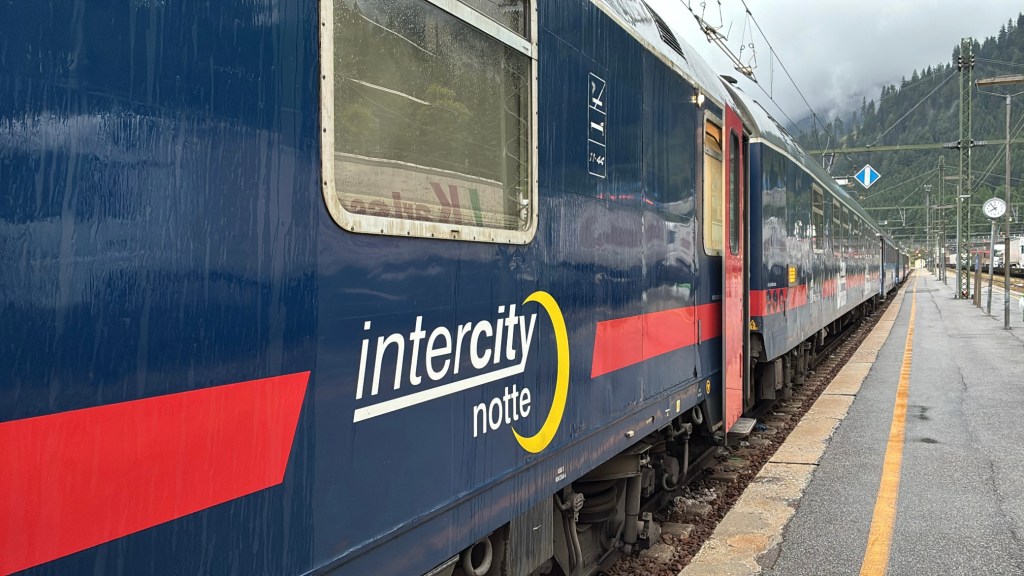
Apart from the classic argument that train travel is on average five times less harmful to the climate than a comparable flight (Greenpeace, 2025), what really annoys me about flying is the endless waiting: Waiting at security, waiting at the gate, waiting in the plane until it finally takes off, waiting at passport control upon arrival, waiting for checked luggage and one last wait for the ordered cab into the city center. With the night train, on the other hand, it’s simply a matter of boarding, having your ticket checked — and if the journey takes a bit longer, you can just turn over in bed and go back to sleep.
Enjoying a meal in the dining car at 200 km/h
Even though there aren’t that many night trains left with a dining car, when there is one, it’s always a highlight. In particular, I’m thinking of the night trains in Sweden, which offer shrimp sandwiches or cinnamon buns, or the Santa Claus Express in Finland, which serves meatballs on real ceramic plates. Dining cars are also places for encounters and exchanges with fellow travelers from all over the world — especially when, due to limited space, you’re seated together at one table.
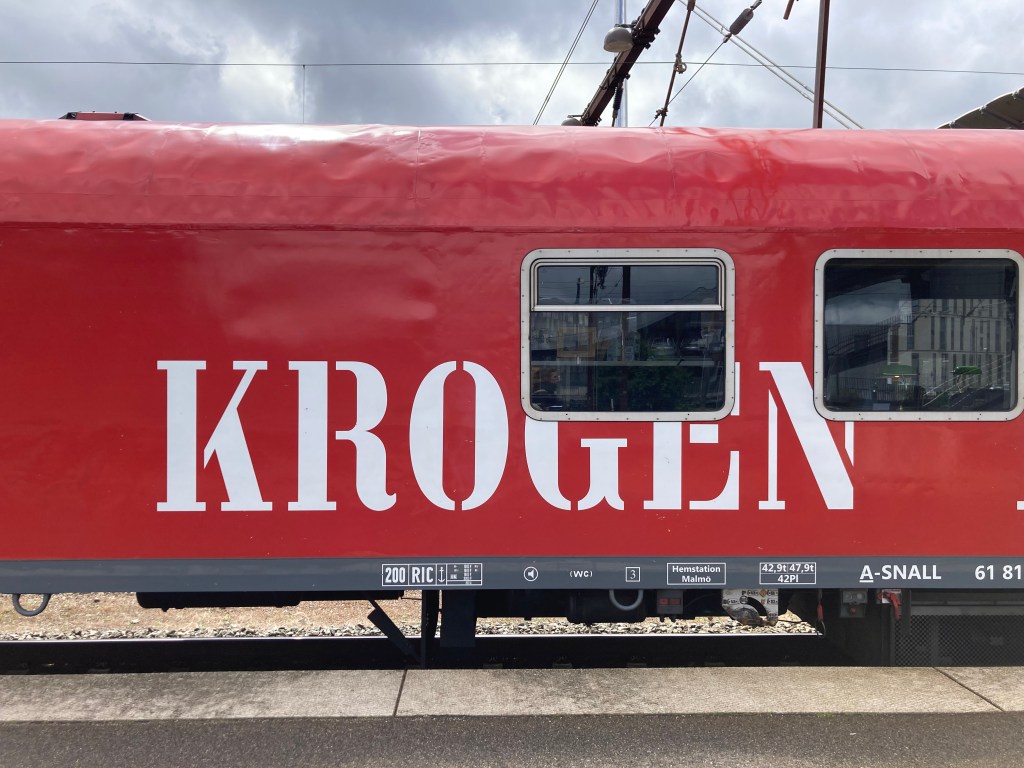

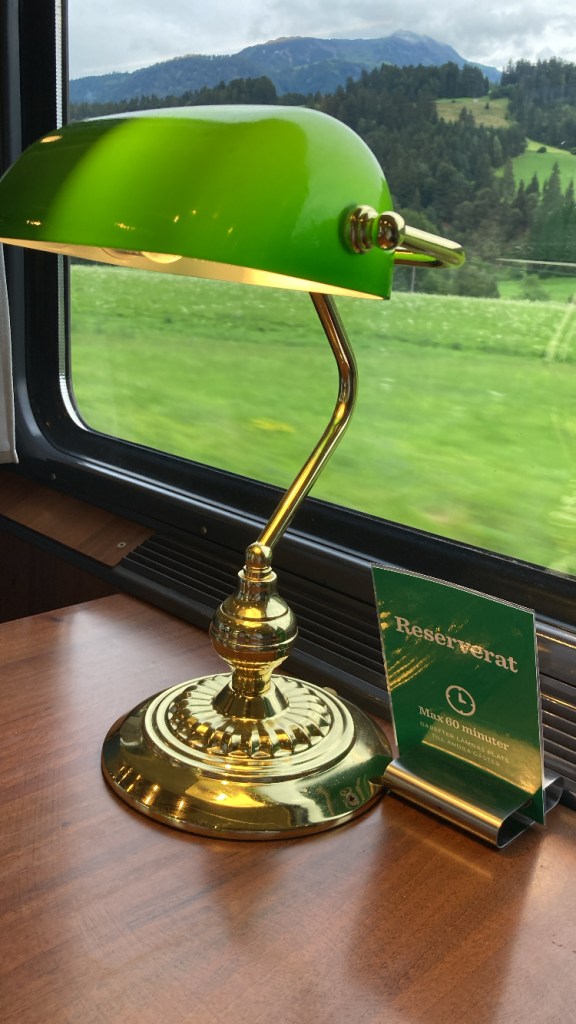
A unique feeling: Enjoying a tasty cooked meal in a charming dining car.
The night train as a journey back in time
Boarding a night train always has a touch of nostalgia for me. It feels like going on a journey through time and that’s not just because of the sometimes old rolling stock. Looking back as early as the 1830s, the world’s first long-distance passenger trains with so-called sleeping cars were put into service (Curtale et al., 2023; Burman, 2015). In 1874, the Belgian George Nagelmackers had the vision of creating a European night train network and founded the „Compagnie Internationale des Wagons-Lits“ (CIWL) — the birth of the legendary Orient Express (Hödl, 2006). At that time, traveling by night train was associated with luxury and travel in general was much slower. Even though I never experienced that era myself, it feels as if I’m immersing myself in that world, at least a little.
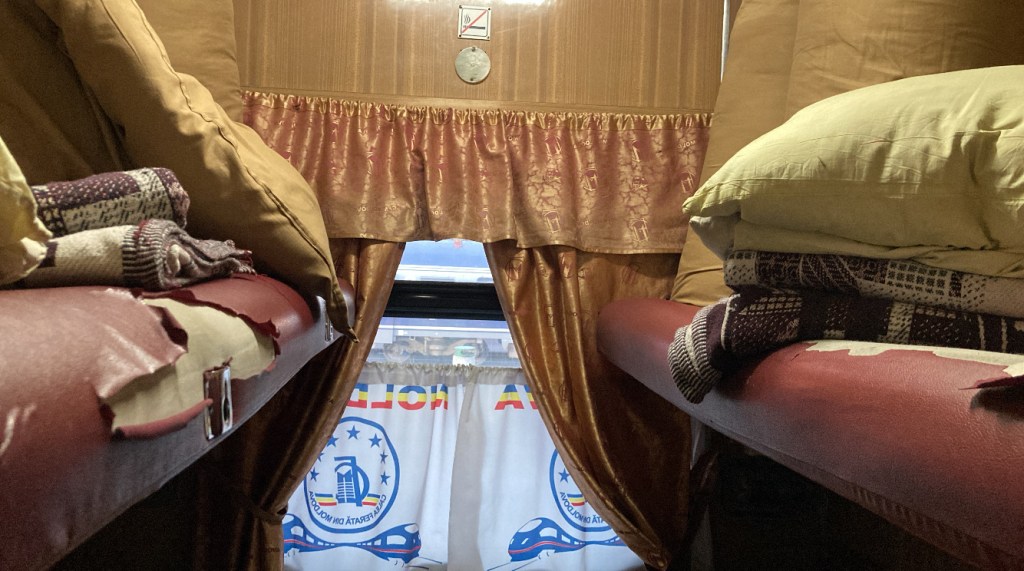
Pure nostalgia: Aboard the older night train from Bucharest to Chișinău.
Getting a sense of distance
Boarding a plane and covering hundreds of kilometers in an hour often feels like cheating. After landing, you could practically be anywhere in the world. It’s different when traveling by night train: Every kilometer is covered consciously. Time and space are in harmony. In my view, train travel also leads to excellent geographical knowledge. You don’t just remember the final destination, but also the location of one city or another along the way— cities you glimpse through the train window in the morning after waking up.
Being on the move
As the saying goes: The journey is the destination. And that’s exactly what I love about traveling by night train. For me, the train is not just a necessary evil to get from A to B — it’s part of the adventure. Or when was the last time you really talked about a flight itself? Seeing snow-covered mountain peaks after waking up in a still-warm train bed, on the other hand, definitely calls for a souvenir photo. It’s also about the feeling of being in motion, even if you’re only slowly approaching your destination. Sebastian Wilken (2025) sums it up perfectly on his blog Zugpost: “I love being on the move. It’s the movement, the constant input for the brain. The landscape passing by is my meditation. New impressions, new thoughts. If I’m honest, I even like being on the move more than arriving. Even as a child, no journey to a vacation destination could ever be long enough for me.”
As you can see, there are many reasons to love the night train. Sometimes it’s an interesting conversation, sometimes a delicious meal in the dining car, or simply the feeling of being in motion. Feel free to let me know in the comments what you especially love about traveling by night train.
Sources:
Andersson, Per J. (2020). Vom Schweden, der den Zug nahm und die Welt mit anderen Augen sah. C. H. Beck.
Burman, F. (2015). Night train. (Master’s thesis, Lund University). https://lup.lub.lu.se/luur/download?func=downloadFile&recordOId=7369889& fileOId=7369895
Curtale, R., Larsson, J., Nässén, J. (2023). Understanding preferences for night trains and their potential to replace flights in Europe. The case of Sweden. Research Square. https://doi.org/10.21203/rs.3.rs-2398247/v1
Greenpeace (2025, 21. August). Low-cost flights up to 26 times cheaper than trains. Retrieved on 20.12.2025, from https://www.greenpeace.org/eu-unit/issues/climate-energy/47717/low-cost-flights-up-to-26-times-cheaper-than-trains/
Hödl, S. (2006). Der europäische Markt für Nachtreisezugverkehre. Eine empirische Analyse der Nachfragedeterminanten. Institute of Transport Economics and Logistics, WU Vienna University of Economics and Business. https://research.wu.ac.at/ws/portalfiles/portal/19841722/document.pdf
Wilken, S. (2025, 20. March). Zugschau: Über das Unterwegssein. Retrieved on 12.12.2025, from https://zugpost.org/zugschau-52/


Kommentar verfassen