Many people complain about the railway. The trains are late too often and people miss their connecting trains as a result. But is there any truth in this statement? To find out, I recorded my train journeys, including delays, over the entire year of 2024. The list mainly focuses on trains in Austria, Germany and Switzerland.
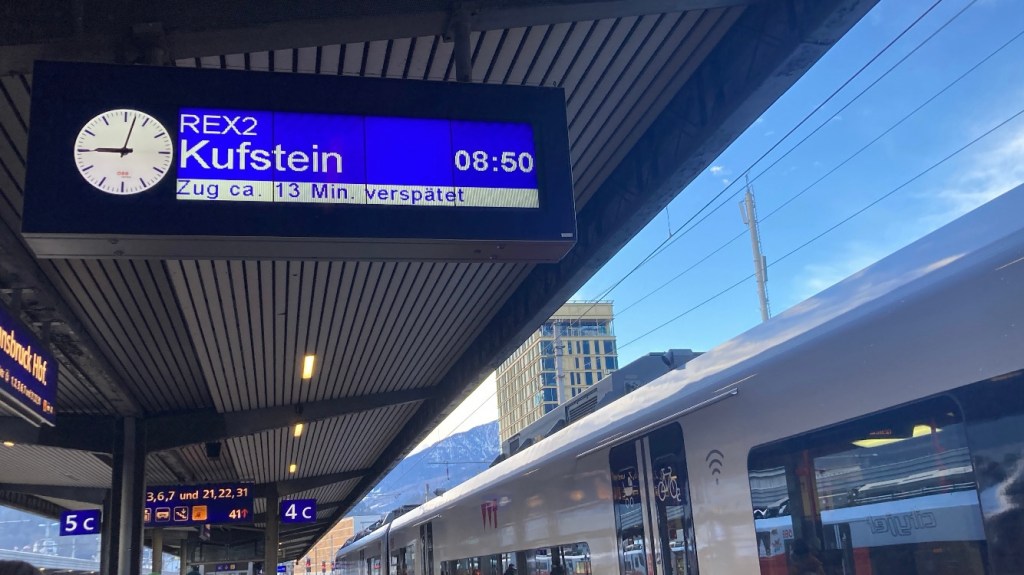
Official delay statistics for 2024
But before we get to my results, let’s take a quick look at the publicly available statistics for 2024.
ÖBB:
The Austrian Federal Railways (ÖBB) was the most punctual in terms of passenger transport in February. There, 95.2% of all trains arrived within the tolerance value of five minutes. In local passenger transport, the figure was as high as 95.8% in August. Long-distance passenger transport, on the other hand, peaked at 84.4% in February. But the data for the latter in particular fluctuate greatly. In September, just 69.5% of long-distance trains were on time (Statista Research Department, 2024).
DB:
The Deutsche Bahn (DB) was most punctual concerning passenger transport in March 2024. There, 91.4% of all trains arrived at their destination less than 6 minutes late. In local passenger transport, the data peaked at a maximum of 91.7% in February. DB’s biggest problem is long-distance transport. Between 52.9% (June) and 67.6% (March) of all long-distance trains reached their destination with a delay of less than six minutes (Deutsche Bahn, n.d.).
SBB:
In 2024 (January – November), the punctuality of Swiss Federal Railways (SBB) passenger services averaged 93.1% (SBB/CFF/FFS, n.d.-1). A train is considered punctual if it arrives at its destination station less than three minutes after schedual (SBB/CFF/FFS, n.d.-2). Passenger trains were the most punctual in February with 94.6%. In terms of regional transport, the average rate was 93.5%. Here, too, February was the month in which passengers reached their destination most punctually, at 94.9%. The high punctuality of SBB’s long-distance services is remarkable. On average over the year, 91.0% of all those trains arrived on time, in February even 93%. This has a particularly positive effect on train connections, where an annual average of 98.7% of all transfers were successful (SBB/CFF/FFS, n.d.-1).

My delay statistics for 2024
Local trains and long-distance trains:
In the whole of 2024, I travelled on 270 trains in Europe. Exactly half of these can be classified as local trains and the other half as long-distance trains (including night trains). This results in the following overview of punctuality:
| countries | % of local trains on time | Ø min of late arrival of local trains | % of long-distance trains on time | Ø min of late arrival of long-distance trains |
| Austria | 86.49 | 1.49 | 73.33 | 6.3 |
| Switzerland | 88.46 | 0.65 | 91.30 | 1.11 |
| Germany | 88.24 | 3.71 | 40.00 | 18.8 |
| AT – DE | 100 | 0.46 | 80.00 | 6.0 |
| CH – AT | 100 | 1.0 | 85.71 | 4.57 |
| DE – CH | 94.12 | 0.71 | 50.00 | 69.00 |
| Others | 100 | 1.32 | 57.89 | 8.53 |
The results show that, with the exception of Switzerland, local trains are more punctual than long-distance trains. Local cross-border connections perform particularly well. The situation is different for long-distance trains. While at least 80% of the connections within Switzerland, between Germany & Austria and Switzerland & Austria are punctual, punctuality in Germany is appalling at just 40%. By and large, it can be said that the data I collected is in line with the officially published data. In both cases, local trains are generally more punctual than long-distance trains.
It is also interesting to look at the average minutes that a train arrives at its destination later than the timetable says. While it is just 0.46 minutes (~28 seconds) for local trains between Austria and Germany, it is 3.71 minutes (~223 seconds) in Germany alone. However, the situation is even worse for long-distance trains in Germany. Here, my data shows that on average trains arrive 18.8 minutes late. In this case connections of less than 20 minutes would be almost impossible to achieve. Switzerland once again shines when it comes to long-distance trains, with travellers arriving just 1.11 minutes (~67 seconds) behind schedule.


Night trains:
This section takes a look at the punctuality of my night train journeys across Europe. The following 14 trains were analysed:
| train number | route | delay (in min) |
| D347 | Vienna – Bucharest | 9 |
| EN40462 | Budapest – Innsbruck | – |
| EN40462 | Budapest – Innsbruck | – |
| EN40465 | Zurich – Feldkirch | – |
| EN40467 | Innsbruck – Budapest | 12 |
| IRN402 | Bucharest – Chisinau | 15 |
| Night-ICE698 | Munich – Berlin | 30 |
| NJ420 | Innsbruck – Cologne | – |
| NJ447 | Feldkirch – Innsbruck | – |
| NJ447 | Innsbruck – Vienna | – |
| NJ447 | Innsbruck – Vienna | 2 |
| NJ447 | Bregenz – Innsbruck | – |
| NJ457 | Berlin – Vienna | 3 |
| Snälltåget | Innsbruck – Odense | 54 |
The results show that 64.29% of night trains arrive at the station on time (up to max. 5:59 minutes late). For journeys within Austria, the trains even achieved a punctuality rate of 100%. Based on my data, on average a night train reaches its destination 8.93 minutes later than the timetable. A look at several critical sources shows that this delay experience of a few minutes can be considered very good with regard to night trains. Graf & Burtscher (2022) even write about delays of several hours on overnight train journeys. The article also states that ÖBB night trains arrive on time in 69.4% of all journeys. As a consequence, the authors cite a shortening of holidays or tedious postponements of appointments for the passengers.

Conclusion
Yes, trains are late, sometimes by several minutes. However, it is important to differentiate between travelling within a country and cross-border travels. While local trains run reliably in both cases and sometimes even achieve 100% punctuality in my data collection, the problems are mostly in cross-border traffic with long-distance trains. While 85.71% of long-distance trains between Switzerland and Austria are still punctual, the figure between Germany and Switzerland is just 50%. In general, DB has a problem when it comes to punctuality. Just 40% of all long-distance trains I travelled on within the country ran according to schedule. The average train delay of 18.8 minutes here also makes you think twice as soon as a connection has to be made. In my observations, Switzerland scores best as a railway country, where even the shortest connections are usually reached.
When it comes to night trains, it should be noted that they are generally less punctual than daytime trains. Border controls and construction work greatly affect their journey times, which can lead to delays. The average 8.93 minutes that I arrived later than the timetable, on my journeys on the night train are justifiable in my opinion. Tip: If possible, always plan enough buffer time for connections after an overnight train journey, so your sleep on board is even more restful.
Sources:
Deutsche Bahn (n.d.). Erläuterung Pünktlichkeitswerte für den November 2024. Retrieved on 28. December 2024, from https://www.deutschebahn.com/de/konzern/konzernprofil/zahlen_fakten/puenktlichkeitswerte-6878476
Graf, M. & Burtscher, I. (2022, 24. August). Nightjet kommt, aber zu spät. Retrieved on 08. January 2025, from https://www.sn.at/wirtschaft/oesterreich/nightjet-kommt-aber-zu-spaet-126103894
SBB/CFF/FFS (n.d.-1). Pünktlichkeit. Retrieved on 28. December 2024, from https://reporting.sbb.ch/puenktlichkeit?=&years=1,4,5,6,7&scroll=1783&highlighted=
SBB/CFF/FFS (n.d.-2). Pünktlich für Sie unterwegs. Retrieved on 07. January 2025, from https://company.sbb.ch/de/ueber-die-sbb/verantwortung/die-sbb-und-ihre-kunden/puenktlichkeit.html
Statista Research Department (2024, 20. November). Anteil pünktlicher Bahnen der ÖBB im Personenverkehr bis Oktober 2024. Retrieved on 28. December 2024, from https://de.statista.com/statistik/daten/studie/466308/umfrage/anteil-puenktlicher-bahnen-der-oebb-im-personenverkehr-monatlich/
 Nights on Tracks
Hinterlasse einen Kommentar