Travelling by night train used to be considered noble, expensive and reserved for the well-heeled upper class. As early as the 1830s, the world’s first trains with so-called bed carriages were in use (Curtale et al., 2023; Burman, 2015). Legendary trains such as the Orient Express offered passengers journeys throughout Europe, from Paris or London to Istanbul (Hödl, 2006). After the Second World War, however, travelling by train overnight became less important (Gleave et al., 2017). Furthermore, the development of low-cost airlines also made air travel accessible to the general public. From then on, it has competed with rail transport (Givoni & Banister, 2006). However, night trains are currently experiencing a renaissance (Dömény & Dolinayová, 2021). But how is this really affecting travel behaviour and why aren’t more travellers using the ever-expanding European night train network? What needs to change so that even more people switch from flying to travelling by night train? You can find out in the following lines, which are an excerpt from my Master’s thesis.

In order to investigate the travel behaviour of night train passengers, I evaluated the responses from 215 questionnaires (study period 18.01. – 11.02.2024). This examines the extent to which the determinants of travel costs, comfort and travel distance affect the choice of transport mode between night train and plane from Innsbruck. I analysed the existing connections to Vienna, Frankfurt am Main and Amsterdam in more detail. In addition, hypothetical routes from the Tyrolean capital were modelled for the final destinations of Berlin and London.
Travel costs
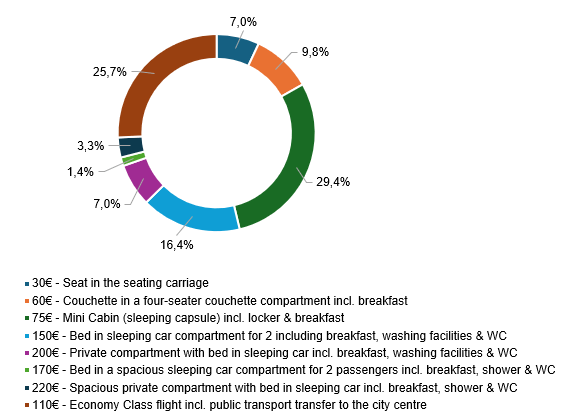
The results show a trend towards early ticket booking. For aircraft, this can be explained by rising ticket prices. According to Expedia Team (2022), domestic flights become more expensive one month before departure. The night train also offers lower prices when tickets are booked early thanks to the so-called ‘Sparschiene’. When booking six months in advance, the Mini Cabin for 75 euros is the most popular option, followed by the 35 euro more expensive Economy Class flight including public transport to the city centre. In third place is the bed in a two person compartment in a sleeper car for 150 euros. In total, around 46 percent of respondents chose a night train category that was less expensive than the average price of a flight ticket, which costs 110 euros.
Travel comfort
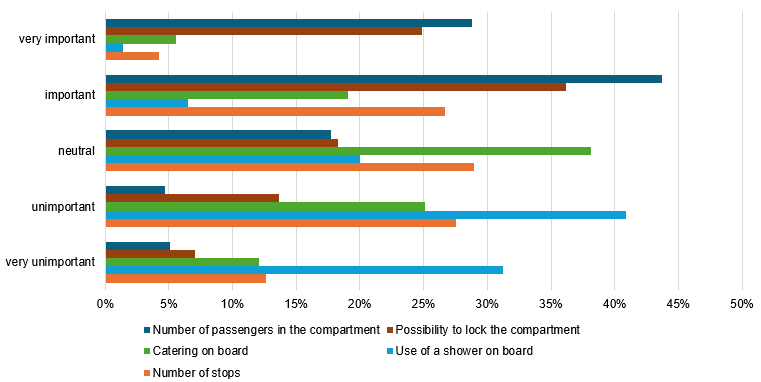
The results show that the number of fellow travellers in the compartment is a key comfort factor for a pleasant night train journey. People who rate the influence of comfort higher, prefer to share their compartment with a smaller number of people overnight. This leads to the conclusion that they prefer more privacy. These results are also reflected in Kantelaar et al. (2022), according to whom people generally do not like to be accommodated together with other people in the night train compartment. According to Buh & Peer (2022), the shared use of compartments even discourages travellers from choosing an overnight train as a mode of transport. The ability to lock the compartment is also seen as ‘very important‘ and ‘important‘. On the other hand, purchasing food on board, the use of a shower on board and the number of stops are not such decisive comfort factors on night trains.
Travel distance
The results show that a person’s willingness to travel by night train decreases as the number of kilometres as well as the duration of the journey increase. While 89% of people prefer the overnight train for journeys to Vienna, this figure drops to three quarters for journeys to Frankfurt or Berlin. From a distance of 640 kilometres onwards or an overnight train journey of 10.5 hours or more, the majority of people choose to travel by plane. In relation to Innsbruck as the starting point, this means that the majority of travellers to Vienna, Frankfurt am Main and Berlin prefer the night train over the plane. This becomes very clear with a fictitious night train journey from Innsbruck to London. Only less than 18% choose the train to the British capital, which is more than 1.120 kilometres away.
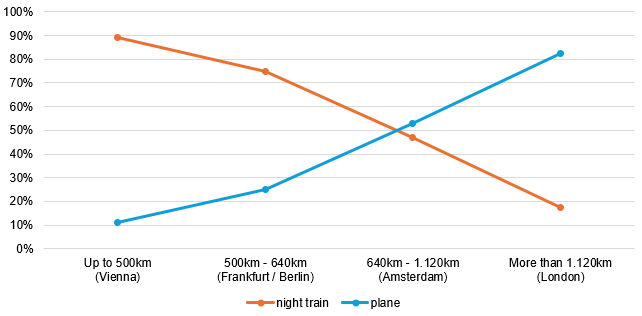
As you can see, in all three categories analysed, night trains are competitive with air travel. To summarise, it can be said that night trains from Innsbruck can compete with air travel thanks to attractive ticket prices, a high level of comfort in the form of privacy and a journey time of up to ten hours over short to medium distances (up to 640 km).
But how can night train operators take advantage of these results and take even more travellers away from the low-cost airlines? Firstly, new night train connections of up to 640km / 10h should be realised, such as Innsbruck – Berlin. Travellers consider this length to be ideal for travelling by night train. For existing connections, providers should try to reduce longer journey times towards the ten-hour mark in order to make them more attractive.
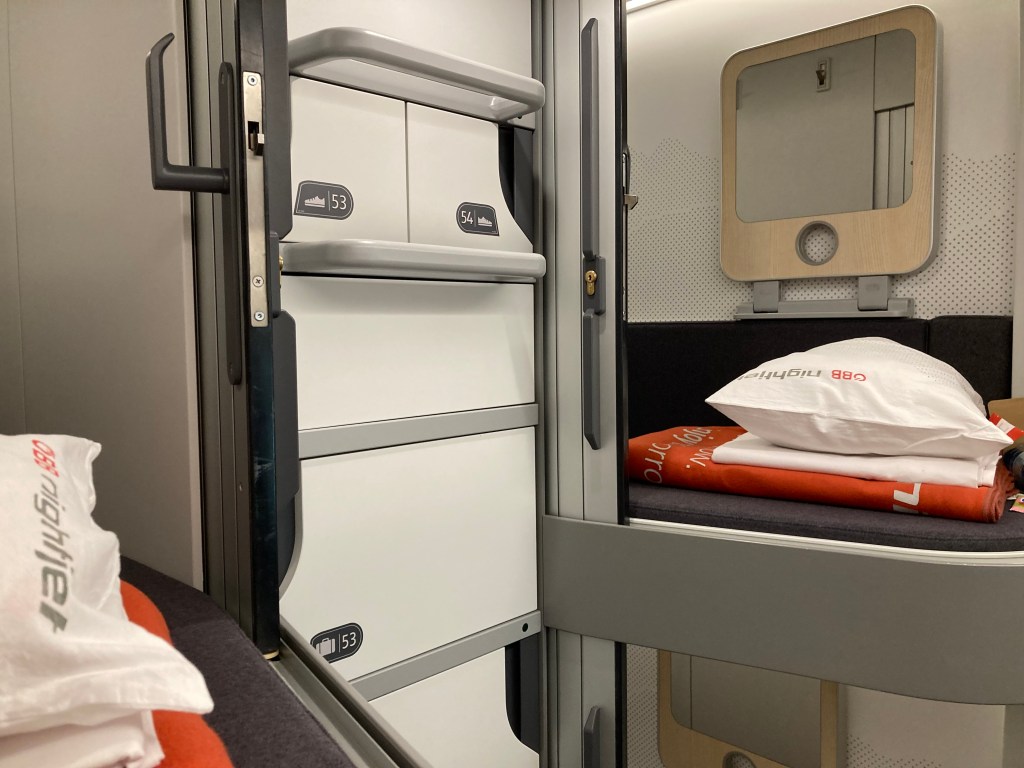
The newly introduced Mini Cabin, which is considered to be the most popular of all options, should also be incorporated into new ÖBB night train sets to be ordered. The trend away from six to four beds in the couchette compartment of the new Nightjet should also be maintained, as people do not like to share their compartment with others. The possibilty to lock the compartment should also be emphasised in the future.
As a final recommendation, attention must be paid to attractive prices in the night train sector in order to remain competitive with air travel. Therefore, ÖBB’s dynamic pricing system, which has been in place since December 2023 and can lead to high prices on popular routes, should be viewed critically.
Curious about the entire Master’s thesis? Feel free to have a closer look at the whole text in German below or incorporate it into your own academic work or blog. If you have any questions or comments do not hesitate to contact me!
Sources:
Buh, B., & Peer, S. (2022). Environmental Concern and the Determinants of Night Train Use: Evidence from Vienna (Austria). WU Vienna University of Economics and Business. SRE – Discussion Papers, 02. https://doi.org/10.57938/60b44fce-cd5d-4b31-9d00-10503e656715
Burman, F. (2015). Night train. (Master thesis, Lund University). https://lup.lub.lu.se/luur/download?func=downloadFile&recordOId=7369889& fileOId=7369895
Curtale, R., Larsson, J., Nässén, J. (2023). Understanding preferences for night trains and their potential to replace flights in Europe. The case of Sweden. Research Square. https://doi.org/10.21203/rs.3.rs-2398247/v1
Dömény, I. & Dolinayová, A. (2021). Possibilities for Introducing a New Night Train Connection in Middle Europe. Transport technic and technology, 17(1), 6–12. https://doi.org/10.2478/ttt-2021-0002
Expedia Team (2022, 19. October). Expedia-Studie Mit Tipps Zu Flugreisen In 2023: An Diesem Wochentag Profitieren Deutsche Reisende Von Günstigen Preisen Und Vermeiden Verspätungen. Expedia. Retrieved on 22. April 2024, from https://www.expedia.de/stories/2023-flugberatung/
Givoni, M. & Banister, D. (2006). Airline and railway integration. Transport Policy, 13(5), 386–397. https://doi.org/10.1016/j.tranpol.2006.02.001
Gleave, S. D., Bird, G., Collins, J., Da Settimo, N., Dunmore, D., Ellis, S., Khan, M., Kwok, M. Leach, T., Preti, A., Ranghetti, D. & Vollath, C. (2017). Research for TRAN Committee – Passanger night trains in Europe: the end of the line?. European Parliament, Policy Department for Structural and Cohesion Policies. https://www.europarl.europa.eu/RegData/etudes/STUD/2017/601977/IPOL_ STU(2017)601977_EN.pdf
Hödl, S. (2006). Der europäische Markt für Nachtreisezugverkehre. Eine empirische Analyse der Nachfragedeterminanten. Institut für Transportwirtschaft und Logistik, WU Vienna University of Economics and Business. Schriftenreihe des Instituts für Transportwirtschaft und Logistik – Verkehr, 02. https://research.wu.ac.at/ws/portalfiles/portal/19841722/document.pdf
Kantelaar, M. H., Molin, E., Cats, O., Donners, B. & Van Wee, B. (2022). Willingness to use night trains for long-distance travel. Travel Behaviour and Society, 29, 339–349. https://doi.org/10.1016/j.tbs.2022.08.002#
 Nights on Tracks
Hinterlasse einen Kommentar